
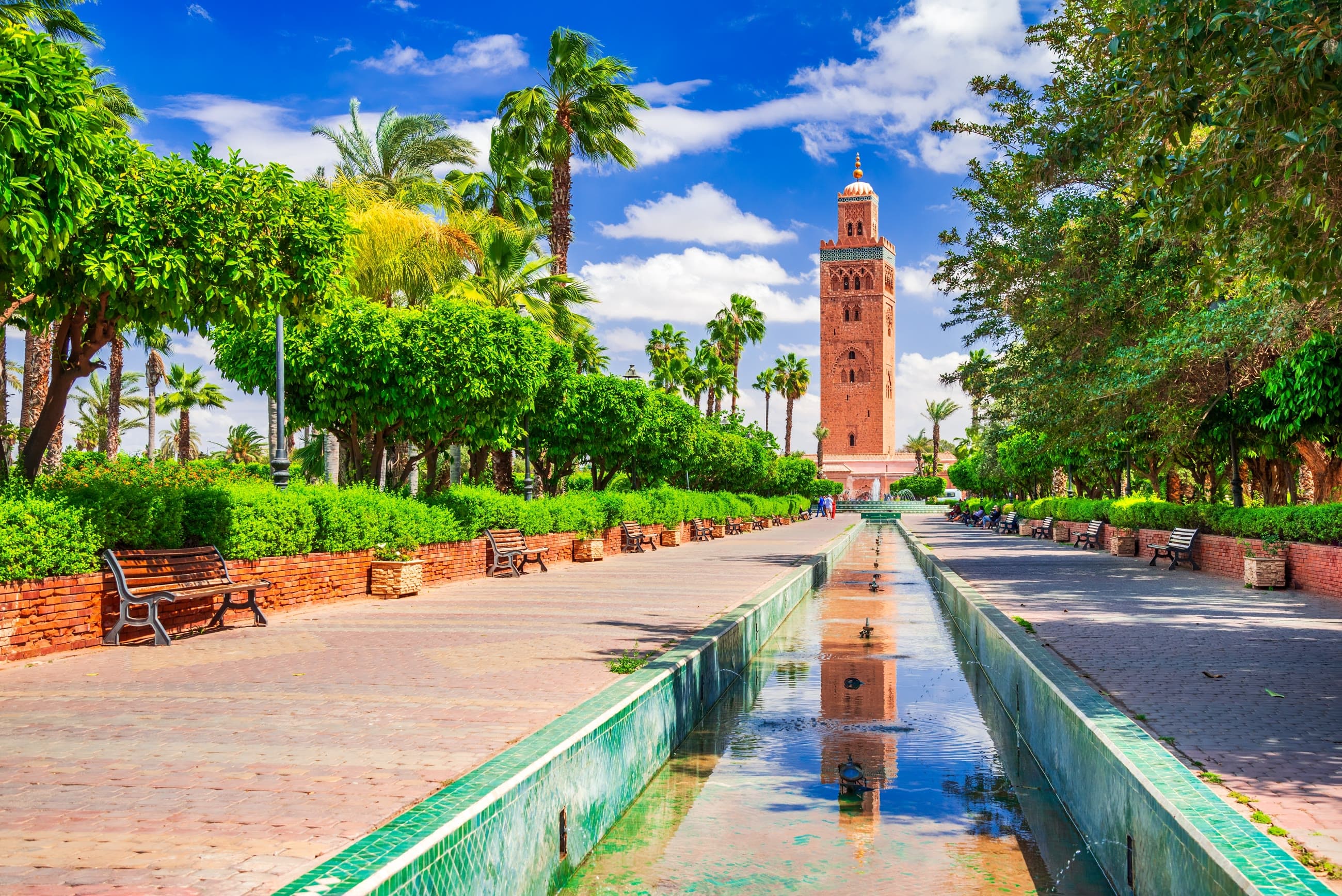
Marrakech in spring, Essaouira at the height of summer, the Sahara in the hollow of autumn: Morocco has a right season for every wish, around 4 hours' flight from Luxembourg. Our honest reading, region by region, with the real temperatures.
“When should we go to Morocco?” calls for an answer in three parts, because Morocco is three climates in one country: a coast tempered by the Atlantic, mountains rising above 4,000 m, and a desert that begins beyond the Atlas. The right time to go is therefore not a date, it is a pairing of region and season. Here is our honest reading, with the real temperatures, so you can time your trip well, whether you dream of medinas, dunes or valleys in bloom.
A word on logistics, because it changes how you decide: Morocco is around 4 hours' flying time from Luxembourg, most often with a stop via Paris, Brussels or Amsterdam, with no time difference in winter and one hour in summer. It is the ultimate “big change of scenery, short journey” destination, and the budget follows the same logic: allow €40 to €90 per day per person on the ground, riad, meals and transport included. The result: you can go often, and therefore choose your season instead of putting up with it.
Spring and autumn: the two royal windows
From March to May and September to November, everything aligns: 25 to 30°C by day in Marrakech and Fez, clear skies over the desert, mild evenings dining on a riad terrace. It is the ideal period for the classic itinerary, imperial cities, the Todra gorges, the Dadès valley and a night in the dunes, without ever suffering from the heat or the cold. These windows suit every wish at once: the labyrinthine medina of Fez can be walked without breaking a sweat, Chefchaouen and its blue lanes keep their mountain freshness, and Jemaa El-Fnaa square regains its full effervescence from late afternoon, storytellers and grill stalls included. It is also, logically, high season: the finest addresses are fully booked weeks in advance, and riad prices climb 20 to 30% compared with winter. If your project fits in one sentence, “see as much of Morocco as possible in the best conditions”, this is where the cursor lands.
Summer: scorching in Marrakech, perfect in Essaouira
Let us be direct: in July and August, Marrakech and the interior reach 35 to 40°C, sometimes more inland. Sightseeing shrinks to between 8 and 11 am, the riad pool becomes the afternoon programme, and the desert is frankly inadvisable. But the Moroccan summer has its escape route, and it is superb: the Atlantic coast. In Essaouira, the trade wind blows steadily and holds the town at 22 to 26°C while Marrakech swelters three hours down the road. A bohemian fishing port, ramparts lashed by sea spray, grilled fish facing the ocean, wind spots for surf and kite lovers: this is seaside Morocco without the sun-lounger cliché, and it is at its best in high summer. Our favourite format for July and August: two or three nights in Marrakech at the start, morning visits and a hammam, then the week in Essaouira to breathe.
Winter: gentle sun in the cities, freezing nights in the desert
From December to February, Marrakech offers 18 to 22°C in the daytime sun: to escape the Luxembourg grey for a long weekend, it is hard to do better 4 hours' flight away. Two realities to know about, however. In the mountains, it is the season of rain and snow: the Atlas can be crossed but not hiked with peace of mind. And in the desert, the day-night contrast is brutal: pleasant in the afternoon sun, the temperature plunges towards 0°C at night in the Erg Chebbi dunes. A night in a Berber camp is still magical in winter, provided you have a good sleeping bag and a serious camp that supplies thick blankets and braziers. In exchange for these constraints, winter gives what the other seasons cannot: limpid light on the kasbahs, sites almost empty on weekdays, and lower rates on riads and flights alike. For a 3 or 4-day city break in Marrakech or Fez, it is actually our favourite season.
The Atlas: spring, without hesitation
For the mountains, the answer is the most clear-cut of all: from April to June the snow melts on the peaks, the valleys explode into green, and the valley of roses perfumes the air around Kelaâ M'Gouna in May. It is the season for treks through the Berber valleys, the hairpin roads of the Dadès gorges and villages perched beneath the almond trees. The continental climate of the Atlas simply requires layers: 25°C in the midday sun, sometimes below 10°C at sunset. For Toubkal and its 4,167 m, aim for May-June instead if you want to avoid crampons and late snow at altitude. September-October also works very well, with golden light as a bonus.
The recap, wish by wish
- Imperial cities (Marrakech, Fez, Chefchaouen): March-May and September-November, 25 to 30°C by day, mild evenings.
- Desert (Erg Chebbi, Merzouga): September-October and March-May, with comfortable nights of 15 to 25°C at camp.
- Atlantic coast (Essaouira): June to September, when the trade wind turns the coast into a 25°C refuge.
- Atlas and valleys: April to June for the flowers and the treks, September-October for the light and the harvests.
- Small budget and quiet sites: December-February outside the holidays, accepting cold nights and possible rain in the mountains.
“In Morocco, you do not pick a date and then a region: you pick a region, and it gives you its season.”
One last administrative detail that often catches people out: a passport is required to enter Morocco, an identity card is not enough, even for a weekend; on the other hand, no visa is needed for stays of up to 90 days. Tell us when you can travel and what you are coming for, medinas, dunes or summits: we will tell you frankly whether your dates are the right ones, and build the itinerary that makes the most of them, driver for the Atlas and desert camp included.
An itinerary built around you, with no packages and no middlemen?
Let's talk about your trip