
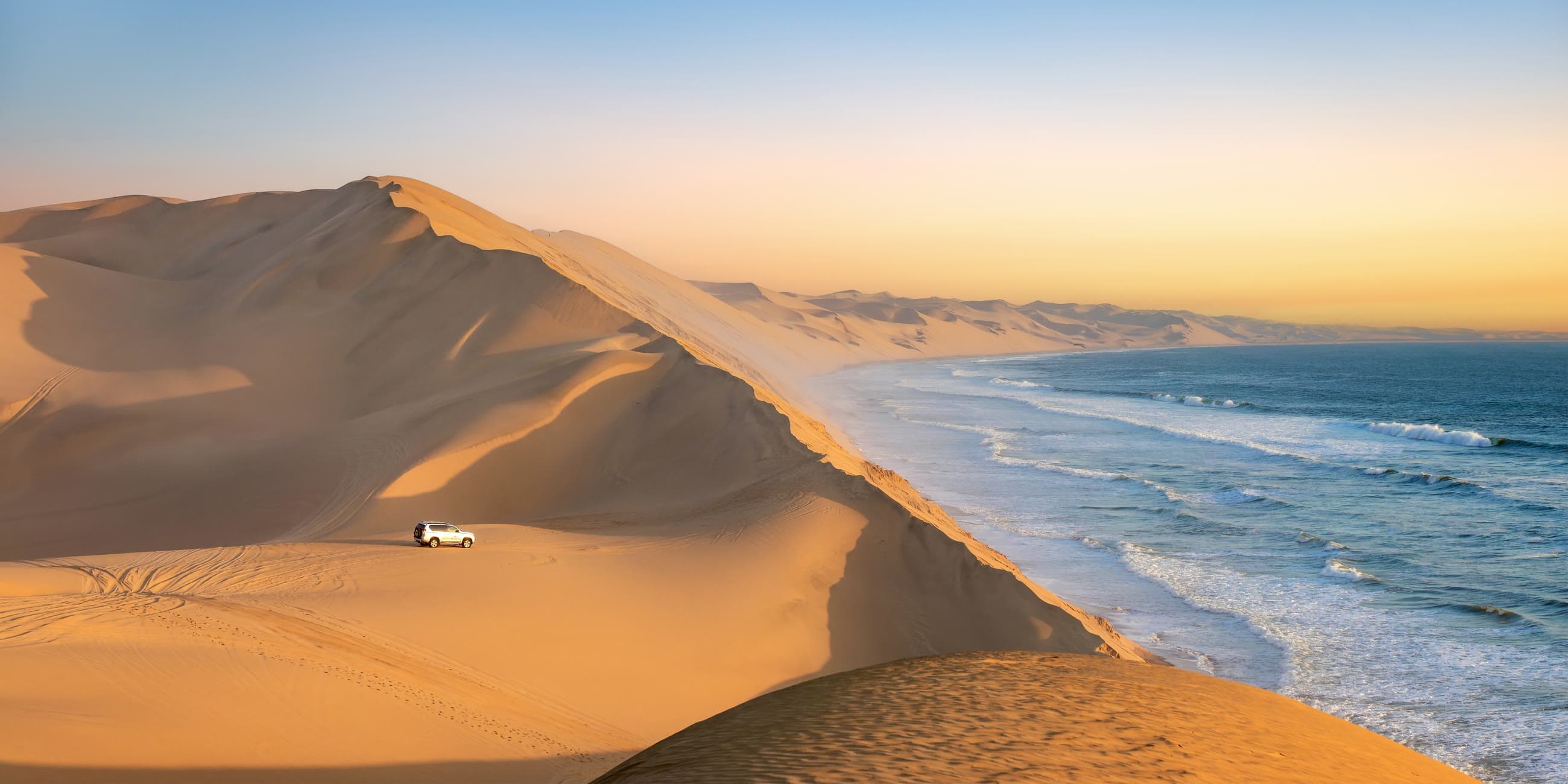
Dry season from May to October for Etosha's wildlife, green season for photographers, freezing desert nights and dawn at Sossusvlei: our honest answer to the question of when to visit Namibia, month by month.
Namibia enjoys a flattering reputation: a country you could visit all year round. That is almost true, and that is precisely the trap. Between the dry season from May to October, when wildlife gathers at Etosha's waterholes, and the green season from November to April, when the desert sheds its skin for photographers, it is simply not the same trip. Here is our honest reading, built on the itineraries we design for this destination, with the numbers to back it up.
One useful reminder before you pick a month: Namibia sits in the southern hemisphere, so its seasons run opposite to Luxembourg's. While you are scraping frost off the windscreen in January, Namibia is in the height of summer, hot and punctuated by thunderstorms. And when our summer peaks in July and August, Namibia is deep in its austral winter: dry, luminous, with daytime temperatures of 25-30°C. The climate is semi-arid to desert across almost the entire country, which simplifies one thing: rain is rare, and it will almost never spoil a trip. The real question is what you are coming to find.
May to October: the dry season, the safe bet for a first trip
If this is your first Namibia, the answer fits on one line: go between May and October. During the dry season the vegetation thins out, the ephemeral rivers vanish, and the animals are left with no choice: they converge on the waterholes. At Etosha, that immense white dried-out lake ringed by waterholes, this turns the self-drive safari into an experience of rare efficiency: you park facing a waterhole, switch off the engine, and the show comes to you. Lions, elephants, rhinos, giraffes, zebras by the dozen: we have rarely seen a park deliver so much in complete independence, at your own pace, with no compulsory guide.
- Who it suits: a first trip to Namibia, wildlife as the priority, families, anyone who wants the most reliable version of the country.
- Skies: near-guaranteed sunny days and crystal-clear night skies, ideal for stargazing at Sesriem or from a remote lodge.
- Plan ahead: this is high season, and the well-placed lodges around Etosha and Sossusvlei book up 6 to 9 months in advance.
July to September: the heart of the season, and peak wildlife
Within the dry season, July to September forms the top of the curve: the waterholes are at their lowest, the animals at their most concentrated, and the night sky at its purest. The Milky Way appears in relief here, in a country where light pollution is virtually zero. This is the window we recommend if wildlife is your absolute priority. May and June deserve a closer look, though: the animals are already starting to gather, prices remain below the peak, and the landscapes keep a trace of green after the rains. For a careful budget, it is often the best compromise of the year.
November to April: the green season, and who is it really for?
Let us be frank: for a first safari we advise against this window, and against November in particular, a hot and unpredictable transition month. From December to February the heat climbs seriously, sporadic rain makes some gravel roads impassable, and the wildlife, finding water everywhere, scatters: Etosha's waterholes lose their magnetic pull. But the green season has its devotees, and we understand them: the desert wears a veil of tender grass, storm skies deliver spectacular light, migratory birds arrive in numbers, and lodge rates drop sharply. If you already know Namibia, if you travel for photography rather than to tick off the Big Five, this is a season with genuine personality. March and April, at the tail end of the rains, offer a country turned green again with weather that is already settling.
Sossusvlei at dawn: the hour that justifies the alarm clock
Whatever season you choose, one appointment is non-negotiable: Sossusvlei at sunrise. The blood-red dunes, rising to 300 m, only reveal their contours under raking light: one face ablaze, one face in shadow, a perfect crest line between the two. Two hours later the sun flattens everything, and the magic drains away. So the maths is simple: sleep at Sesriem, at the gates of the park, so you can pass through the gate at opening time and reach the dunes before sunrise. A few minutes away, Deadvlei awaits: its acacia trees, which died 600 to 700 years ago (the trees themselves were around 900 years old) and stand frozen in a white clay pan, form what is probably the most famous image in the country. It has to be earned at dawn, before the heat and the crowds.
The mental map: choose by desire, not by calendar
- Wildlife at Etosha: July to September for maximum concentration at the waterholes, with May and June a very strong second choice.
- Photography and dramatic light: the green season, December to March, for storm skies and a desert turned green.
- Starry skies and the Milky Way: the dry season, when the air is at its purest, with crystal-clear austral winter nights.
- A controlled budget: May-June or the green season, when lodges cut their rates noticeably.
- To avoid on a first trip: November, hot and unpredictable, and the heart of the austral summer from December to February.
That leaves the logistics, which weigh on your choice of dates more than you might think. Allow 13 to 15 hours of flying from Luxembourg, with 1 or 2 stops via Frankfurt, Brussels or Johannesburg: a journey that makes sense over 10 to 14 days, not over a single week. Once there, a 4x4 is essential for most gravel roads, and the distances deceive: Windhoek to Sesriem is around 350 km (then another 65 km to Sossusvlei) and 4.5 to 5 hours of driving, much of it on gravel. As for the daily budget, allow €60 to €110 per person per day excluding flights, staying in comfortable lodges with vehicle and fuel included, and €50 to €100 more per night for high-end lodges. Namibia is not a budget destination, but at this level of space and silence, we have never heard a traveller regret the bill.
“In Namibia, the season does not change the beauty of the country. It changes what the country agrees to show you.”
Torn between July for the wildlife and May for the budget? Tell us your possible dates, your trip length and what you most want to experience: we will give you a straight answer, even if that means suggesting you shift by a month. And we will build the itinerary to match, with lodges spaced at the right distances and that dawn at Sossusvlei included.
An itinerary built around you, with no packages and no middlemen?
Let's talk about your trip